


 July 2nd could mark the beginning of the end to Prop 8, the controversial initiative that stripped California's LGBT population of the right to marry.
Why? Because on July 2nd, the first hearing of the federal case brought against Prop 8 by power team Ted Olson and David Boies will be heard in the North California U.S. District Court with the case assigned to Judge Vaughn Walker.
Even more dramatically, Olson and Boies, who have an amazing track record of winning cases, had requested a preliminary injunction against the initiative while the courts heard the merits of their case. In other words, this would have put the enforcement of Prop 8 in the Golden State on hold during the trial, consequently allowing same-sex marriages to occur again.
The hearing on July 2nd would've centered around the merits of the injunction, but Judge Walker had other thoughts in mind, calling recently for a move to “proceed expeditiously to trial."
“Given that serious questions are raised in these proceedings ... the court is inclined to proceed directly and expeditiously to the merits of plaintiffs' claims," the judge declared. “The just, speedy and inexpensive determination of these issues would appear to call for proceeding promptly to trial."
(See Case Document and Motion for Preliminary Injunction, Judge Walker's Order for Trial)
This can be seen as a very good sign. The arguments for an injunction mirror the arguments to end Prop 8 altogether, and as the judge stated in his order, this simply demands that a trial must begin right away. Why put a "band-aid" on the situation uation when you can end the pain altogether?
“We are encouraged that the judge wants to dispense with the preliminaries and move quickly toward a final ruling on the unconstitutionality of Proposition 8," Olson said in a press release. "This case is about protecting people's fundamental Constitutional rights, and we agree that it is in everyone's best interest to resolve this matter as quickly as possible. We are prepared to move forward at as fast a pace as the court desires.”
Prop 8 may be history very soon. That's a lot to take in. But that's what would happen in the best of circumstances. Many different circumstances can shift the fate of this case and how Prop 8 continues its reign over California.
It can be confusing sorting out all the facts, especially given some of the controversy surrounding the case. So I decided to go straight to the source for clarification on all the different possible outcomes and ramifications and spoke to the team taking the Prop 8 to task.
But first, some background.
How the Case Began To find out how the case came into being, I went to Chad Griffin. Chad, who is openly gay, began his political career over a decade ago as the youngest person to work on a president's West Wing staff and now works for his own political and communications strategy firm, Griffin Schake.
Similar to the experiences of millions of LGBT across the country, Chad told me about his own on election day. "I'm a political strategist - I was devastated like everyone - such a bittersweet experience with Obama becoming president while the banning of gay marriage in California and gay adoption in my home state of Arkansas passed. It was very difficult to celebrate."
After allowing only a few hours to be depressed, Chad and some politically progressive friends, such as movie director Rob Reiner, producer Bruce Cohen and screenwriter Dustin Lance Black, began discussing what was next.
"We're in a war, and we discussed where we could take the war. If you have a single goal in winning that war, you want to have the opposition on the defensive on all fronts," Chad said. By the end of their discussion, they believed a federal case against Prop 8 would be a powerful next step.
Not long after, these friends, along with Griffin's business partner Kristina Schake, founded the American Foundation for Equal Rights (AFER), created with the sole purpose to support this case. Not long after, they announced the board.
But who was to fight this case?
How Ted Olson and David Boies Took Up the Case
Chad recounted to me the night that he and the future board members of the AFER discussed next steps.
"We went down this path, discussing where donors can be putting their money and activists where they could be spending their time. In our discussions, someone mention that perhaps [Ted] Olson held the same view as us on gay marriage. I responded with skepticism and doubt."
Why such doubt? If you recall the infamous presidential election of 2000 and the historical Bush V. Gore Supreme Court case which effectively determined the final result of the contested 2000gt;2000 Presidential election. Guess who argued for Bush. Ted Olson. He was later appointed by Bush as U.S. Solicitor General and served in the position until 2004.
Chad put aside his skepticism and gave Olson a call and was pleasantly surprised. They agreed to meet in Washington DC where Olson began to inform Chad of his impassioned beliefs for the equal rights of all LGBT.
"I realized I could be sitting in the room with the most eloquent, articulate game-changing spokesperson of our movement. As the conversation went on, I was quite impressed with his analysis of the legal aspects," Chad told Unite the Fight. "We discussed timing, on now versus wait, and the arguments that could be used for and against, and the impacts on the LGBT community - how state sanctioned discrimination leads to the real life consequences, such as rising suicide rates in LGBT youth, who are being kicked out of their homes when they come out. Ted expressed his long held personal views of support for same-sex marriage."
By the end of the meeting, Olson was on board, but Chad believed an "equally prominent co-counsel" was needed to push the case to the forefront of the fight for equal rights.
Olson suggested another powerhouse attorney David Boies, the lawyer he faced down in the Bush V. Gore case. Equally prominent indeed.
It didn't take long to get Boies on board, and the once opposing attorneys immediately got to work. With two sets of same-sex unmarried couples with a desire to marry acting as plaintiffs, the case was filed and immediately, the media frenzy began. (AFER press conference.)
Criticisms Against the Case
Immediately, large organizations objected to the case, calling it premature and fearing that a loss could set back the marriage equality movement years if not decades. The ACLU told Time that "The U.S. Supreme Court typically does not get too far ahead of either public opinion or the law in the majority of states."
"Look at the Loving vs. Virginia case – if Loving would have waited for public opinion to catch up, they would have waited years if not decades," Chad told me. "Only 17 percent of the American public were in favor of interracial marriage."
"We’re now approaching 50 percent of the American public [in favor of marriage equality]. We have six states with marriage equality. The Supreme Court and our court system was not designed to wait on public opinion," Chad continued.
"We can all agree to disagree on different tactics but at the end of the day, we all have the same goal - we can all agree on winning full federal rights for all lesbian, gay, bisay, bisexual and transgender people," Chad told me. But in most cases, "The response to the case has been overwhelmingly positive."
AFER has also continued to talk to the specific organizations that originally objected, and after hearing more about the case, they have reacted more positively. Since this discussion, the ACLU has done a 180 and along with other organizations, has filed "friend of the court" briefs in support of the case, as well as California Gov. Schwarzenegger and Attorney General Jerry Brown.
This led me to more specific questions. Why go federal now, especially with a divided Supreme Court with a conservative makeup? What's the grounds of the argument of the case?
Chad humbly admitted to not being a lawyer and kindly directed me to Ted Boutrous Jr., partner at Gibson, Dunn and Cruther of which Ted Olson is also a partner.
But before signing off, Chad said, "I don’t think it’s correct to say that we have a divided [Supreme] Court – we have a 4/4 with Kennedy being a swing vote. The last two gay cases winning with a 5-4 vote."
The Timing and Specifics of the Case
"We think we can win and can win now," Ted Boutrous told me. "Based on the Supreme Court decisions in the Lawrence vs. Texas and Romer vs. Evans [gay rights] cases, the arguments are extremely strong."
"Olson and Boies believe we can win now, and to win, you have to go in and give the arguments," Boutrous continued. "It’s been the Supreme Court that has really been the change agent when it comes down to striking down discriminatory laws."
Olson has a 75% win for his cases with Boies having an equally impressive track record, and both have argued numerous cases in front of the U.S. Supreme Court. If they believe we can win, that's not something you take in lightly.
In talking with Boutrous and reading the AFER website, I learned of the core arguments supporting the federal case against Prop 8.
According to the suit, Prop 8:
- Violates the Due Process Clause by impinging on fundamental liberties.
- Violates the Equal Protection Clause of the Fourteenth Amendment.
- Singles out gays and lesbians for a disfavored legal status, thereby creating a category of "second-class citizens."
- Discriminates on the basis of gender.
- Discriminates on the basis of sexual orientation.
 First, the case must be heard in the North California U.S. District Court by Judge Vaughn Walker. As mentioned, the hearing begins on July 2nd, and on this day, Judge Walker and the attorneys on both sides of the issue will determine how to “proceed expeditiously to trial."
Second, most likely either side will appeal the ruling if it goes against their liking. In this case, it will then reach the United States Nintes Ninth Circuit Court of Appeals.
It will only be after that ruling will either side appeal to go to the U.S. Supreme Court. But even then, the high court may not hear it. They will have to decide whether or not to take the case certiorari, which is the decision of the court to review a lower court's opinion by "rule of four." This means, four Supreme Court justices have to agree to hear the case.
Though one could never predict how the Supreme Court justices will decide, one major deciding factor tends to be whether or not the lower courts have made opposing decisions favoring one side or the other.
Either way you look at it, it could be awhile before the U.S. Supreme Court hears any case on Prop 8.
But I still had questions about the ramifications of the case going through the court system. What if the case wins? What if it loses? What effect, if any, will it have on a new initiative to repeal Prop 8 in either 2010 or 2012?
Ramifications of the Federal Case Against Prop 8
"First, we strongly believe we’re going to win," Boutrous reiterated. "Second, whatever the court rules, it will be a crucial and necessary step to ultimate victory in equality for all. It’s not an all or nothing case."
When I asked him what he meant, he explained, "This case will lay the foundation and create building blocks for future cases. Unless the courts begin now to examine these federal constitutional issues, it could be decades before progress is made."
But isn't it still a big risk for the movement?
"When you file a lawsuit like this, lawyers and clients need to do an analysis, and we determined now is the time do raise these challenges," Boutrous said, again pointing to the phenomenal expertise of Olson and Boies. "You do have to factor in the inherent challenges - We expect to win."
"You’re not going to be able to gain your constitutional rights unless you go into court and argue for them," he noted. "We think either way its crucial to get this issue before the Supreme Court now, or it can take 10, 20 30 years before we gain equality for all. We think this is the time to raise these claims, we think we’re going to win."
So what will it do for our rights if the case gains final victory?
"It could lead to the elimination of barriers across the country by the way the ruling is framed," Boutrous answered.
But specific rights gained either just in California or nationwide lie in the details of the Supreme Court ruling itself, which no one can predict.
"With the Supreme Court, it could rule broadly [for all of the nation] or a targeted way against Prop 8, but we believe either way, the ruling would have signification ramifications across the country," Boutrous told me.
In other words, California LGBT residents may earn back their right to marry, but the state-by-state battle would still continue. Or, the Supreme Court can say to hell with all the laws in the nation banning same-sex marriage, and the whole U.S. LGBT population will finally be allowed to legally marry and gain federal recognition.
How will this case affect a repeal Prop 8 effort in California in either 2010 or 2012?
Boutrous echoed Chad's earlier words about fighting for LGBT rights on all fronts, both at the local level and at the federal level. If Prop 8 is overturned through a voter referendum, it could in fact render their case "moot."
"We could very likely be geared to file a lawsuit in another state that c that continue to ban same-sex marriage. If Prop 8 were overturned at the ballot box, we would likely take everything that we have done in California and fight the battle there."
"Olson and Boies are on opposite sides of the political aisle. We think, to the public, this could help enhance the likelihood of success at the ballot box," Boutrous continued. "If the worst news we get is that the voters have wiped Prop 8 off the books at the ballot box, then we will reevaluate our case with smiles on our faces."
After talking to the very helpful Ted Boutrous Jr. and Chad Giffin, I was ready to type up everything I learned and share it to the Unite the Fight readership.
But then the horrible and offensive Department of Justice (DOJ) brief defending DOMA was released under the watch of Obama's Administration in reaction to another federal case. As I got caught up in reporting on the brief, I kept thinking, "What bearing at all does this have on the Prop 8 case?"
The Consequences of the DOMA Brief for the Federal Case Against Prop 8
Armed with new questions, I was directed to to speak to Gibson Dunn and Crutcher partner Matthew McGill, who is on the Prop 8 litigation team at the firm.
I jumped right in, asking, "The DOJ just issued a brief defending DOMA, and stated that 'DOMA Is Consistent with Equal Protection and Due Process Principles.' Though your case is against Prop 8 and not DOMA, doesn't this still cut down the core of your argument against it? How will this affect your case?"
McGill didn't skip a beat.
"We don’t think it affects it very much if at all," he said. "The analysis is quite different as to whether a federal statute violates the [Equal Protection] principles as opposed to this particular state provision. We think it’s an entirely different analysis."
"We think that the government's defense of DOMA is quite wrong and wrong-headed. It’s not a defensible position for any number of independent reasons," he continued. "When the government discriminates, it has to have a reason. For certain forms of discrimination, it has to have a really powerful reason."
"Some of the interests that the government might use to defend DOMA arise out of the fact that the federal government uniquely has to deal with 50 states plus DC and Puerto Rico and other territories and all of these state regimes at the same time," McGill said. "The federal government argues this allows it to apply the lowest common denominator when it comes to marriage equality. It only need recognize as valid marriages the stingiest state view of marriage."
So where does Prop 8 fit into this?
"That argument is simply not available to defend Prop 8," McGill answered. "[California] is not in the position of the federal government having to contend with 50 different legal regimes."
"When you’re taking on a federal statute like DOMA, you’re taking on the United States," McGill told me. "I think part of the reason we’ve chosen at this point to limit our challenge to Prop 8 is to take things one step at a time. When people heard that a federal lawsuit had been filed, they assumed it was an all or nothing gambit for those seeking marriage equality. And that’s simply not true. We’d be very satisfied to establish marriage equality in California, and then work from that precedent to move and take on the next battle in a position of strength."
Thursday, July 2nd
So, with my questions having been answered by the helpful team fightm fighting Prop 8, I now wait with bated breath for Thursday, July 2nd, to watch them in action as the hearings for the case begin, leading hopefully to a speedy trial, and ultimately, the end of Prop 8.
No one said this was going to be an easy fight, nor did they claim there was one path to victory. But in my humble opinion, it can't hurt to be fighting on all fronts, including the extremely difficult federal front. But with the amazing Olson and Boies on our side, a team that Chad beautifully described as our movement's "grandest of coups," how can we not support it?
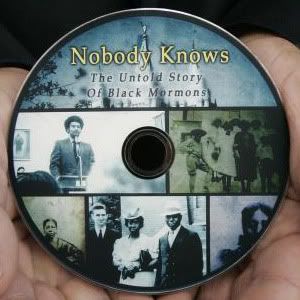 I've just finished watching a fascinating (to me) documentary on DVD that attempts to tell the story of black Mormons, who - according to the liner notes - "have been a continuous presence in the LDS church from its earliest days." The creators bring an insider's POV - but don't flinch from grappling with Mormonism's racist past - and I applaud their effort and welcome the Mormon conversation it has engendered.
That said, it wasn't the film's treatment of historical injustice that provoked me to write this post, but rather what the clip below reveals about an ongoing and very present cause for concern.
First, a quick synopsis to set up the clip:
00:00:00 - Faithful young Mormon couple, parents of nine
00:00:55 - Their encounter with racism inside the Salt Lake Temple
00:01:13 - "You speak such good English!"
00:01:25 - This worthy Mormon family is apparently not appropriate for LDS church media? Good enough to tithe, to attend the Mormon Temple, but not good enough for Mormon magazine covers? What is it with NOM the Mormon church and its addiction to artifice and actors?
And here it is, a short excerpt from Nobody Knows: The Untold Story of Black Mormons ...
For the record, I have no association with the folks who created Nobody Knows.
I'm too busy with my own documentary project (and I could probably use some help with the title, because it seems a bit long) ...
"Everybody Knows Except the Mormons Who Never Got Told: Why a religion so rigid that until today it's still grappling with the meaning of interracial marriage in its own church culture decided to bankroll a nationwide campaign to define marriage for the rest of the country."
I love you, Katie...
 July 1, 2004 Eleven o'clock in the morning at the Apricot Cat and Black Dog Bed & Breakfast in Vancouver, British Columbia, Canada
|  |
This post is a flashback describing our trip to lovely Vancouver to tie the knot back in 2004. Who knew that we would see the day when our marriage would be recognized in the United States? Our marriage is recognized in a few states (and as a civil union or domestic partnership in others), but we're second-class citizens in NC. No hate crimes law, no state anti-discrimination on the books (never mind benefits); at least we can celebrate signing into law of an anti-bullying bill.
Marriage equality continues to thrive in small pockets in our country, and one of the best ways we can cultivate support and effect change is to bring those marriages back home where these commitments are not legally recognized. Not to challenge the legal wrong, mind you (it's going to be decided by the U.S. Supreme Court in the end), but to become visible married couples in our communities - living marriage out of the closet before our friends, neighbors, and work colleagues.
Visibility challenges assumptions; show willingness to explain to potential allies how your legal-somewhere-else marriage is denied where you live.
The f The fact is we will prove by example that our relationships will not cause an end to anyone else's marriage or destroy society, and it will move all of us closer to full civil equality.
***
Our blast-from-the-past photo album is below the fold.
That year we wrote former Senator Elizabeth Dole and the White House about our opposition to the Federal Marriage Amendment and received these responses (note how the form letter from Dole addressed us as "Catharine and Pamela Spaulding" -- what an irony!). Dole | Bush .
Day One - June 30 - Travel Day
We left in the early AM, flying America West from Durham to Phoenix and then to Vancouver.
 |  |
| This is the view from the airplane as we approached Vancouver. We were relieved after landing that it was in the high 70s. | Yes, I had to take this cheesy shot. |
| It was a time consuming wait clearing customs, but it was straightforward. We did currency exchange and took a cab. The first order of business once we arrived at the B&B, was to drop off our bags and walk to the nearest marriage license bureau (below), which is in Chinatown on 8 West Pender Street. It cost C$100 for the license. |  |
 |  |
| Here's Kate at the marriage license bureau. This building is in the Guinness Book of World Records as the narrowest office structure in the world. | Here's an article on the building. Click to enlarge. |
 |  |
| YES! We have the official paperwork partially completed and paid for. Now we take it back to the B&B to complete in the presence of the marriage commissionaire at the ceremony tomorrow. | Time for some brief sightseeing in Chinatown, which is an older part of downtown Vancouver. |
 |
 |
| Hon's. We went to the original main location; there is a more trendy store on Robson Street, the more touristy downtown area. | For some reason, Kate is into Hello Kitty, so this is a nearby novelty shop that had the characters on strange slinky springs. Kate: "It's the secret symbol of gay pride (or to identify yourself as being gay) in Asian countries where it is typically unacceptable." |
| We went back to the B&B around 5:30, hoping to get there before Tim (Pam's brother) arrived. He actually pulled up just a few minutes after we had walked back - great timing. Tim was in the middle of moving to a new pad, and finishing up his book project, but he put it all on hold to come be with us for the wedding. Gotta love him! We got him settled in and then we all caught a cab to Stanley Park, which is a major tourist attraction in Vancouver. One of the best known restaurants is The Fish House at Stanley Park. We can recommend the salmon; Kate thought the restaurant was overrated. We did a lot of walking afterwards, exploring the downtown area around the waterfront. It was quite crowded, lots of tourists and local, enjoying the sunny, unusually warm weather in the area (80s F). | |
| Tim and Pam at the at the Fish House at Stanley Park. |
 |
 |
| The bike/walk/skate path along Stanley Park and downtown. | A good view of the waterfront. |
 |  |
| Had to crop out some really silly looking/acting folks in this one. | As we got closer to downtown, this weird sight caught our eye -- trees growing on rooftops. |
We had dessert at a place downtown on Denman Street called True Confections, and there were some heavenly choices there --cheesecake and tiramisu (and 3-berry pie) are recommended. Good thing we were walking it off for several hours.
 |  |
| We walked all the way to the other side of the peninsula to the yuppie marina area. | Sunset is really late here in the summer. It didn't get dark until 10PM. |
 |
|
| All of us were really wiped from the plane rides and walks but we had a great time. We cabbed back to the B&B. | Tim stayed on the third fthird floor of the B&B and we stayed in the lovely Lilac Room. Sara Ratner, the proprietor of the B&B, has created lovely surroundings for her guests! |

Day Two - July 1 - Our Big Day (and Canada Day too!) Getting ready was nerve wracking. Sara served us some fantastic buttermilk waffles and the three of us enjoyed a leisurely breakfast and gabbing that resulted in only an hour to shower and get dressed before the marriage commissionaire arrived!
 |  |
| Oh you know, these are more corny "getting ready" shots you have to have... | We put Tim to work on this project. |
 |  |
| He did a great job! | Kate's ready... |
 |
Pam's ready... |
 |  |
| Last shot before the big event... | Sara Ratner, the wonderful B&B proprietor. |
 |  |
| The lovely table setting. | A picture before things get rolling. |
 |  |
| Another shot before the ceremony got started | Are we ready? We were barefoot for the ceremony! |
 |
 |
| We're really nervous. | Pat Mitten, the marriage commissionaire (equivalent to a justice of the peace in the U.S.) beginning the ceremony, which was in the backyard of the B&B. |
 |  |
| Listening to Pat. | Vows. |
 |
| Sara made these for us. |
 |  |
| More vows. | Neither of us remember much about this - so surreal! |

 |  |
| We're married! | The joyful couple with our "best person". Sarah (Kate's sister) -- we know you were there in spirit! |
 | |
| It was a beautiful, sunny day. | We were ecstatic. |
 |  |
| Unbelievably happy. | Down to business -- all have to sign documents post-ceremony. |
 |
 |
| Pat Mitten looks on. | Tim, as a witness, signs. |
 |  |
| Everything was just perfect. | Sara signs, as a witness. |
 | |
| The signing is complete. We now have to wait about a month for the final marriage license, which has to be processed and mailed to us. | The happy feet! |
 |  |
| The rings. | A closer look. |
 |  |
| Some pictures in the front yard. |
 |  |
 |  |
| The B&B sign. |
 |  |
 |  |
| We went back in and Sara had the cake ready (FYI, vanilla cake made with Splenda, along with fresh raspberries,). |
 |  |
| Cutting the cake. | We are;We are incompetent at it. |
 |
 |
| Finally, a slice! | One bite for Pam... |
 |
| One for Kate... |
Stonewall Anniversary Poem
by Governor Barbara Roberts
From Stonewall to Salem, Across this whole nation We've marched and we've lobbied, Forty years in duration. For fairness, equality For dignity and rights For safety, and partners To turn on the lights. To come out of the darkness, Emerge from the closet, To rise above hatred And the bigots who cause it. The path has been long With hurdles and roadblocks But the future looks bright With adoptions and wedlocks. So on this eve of Stonewall We celebrate gains We stand shoulder to shoulder For the work that remains. We thank all who have given, Taken risks, led the way Lesbian, Trans, Bi, Straight and Gay. So - lift up your glasses And your hearts - one and all As we toast our martyrs and heroes And the brave souls of Stonewall.



No comments:
Post a Comment